Showing posts with label bible. Show all posts

Tuesday, January 03, 2023

Daily Prayer App

A practice I want to pursue this year is to use the Daily Prayer App from Church House which offers the daily lectionary readings from the Church of England along with a podcast.

There are morning, evening, and nightly prayers. I don't think I have the discipline of a monk to pray the hours (grin) so I'm sticking with the morning readings. One of the opening prayers is this reminder:

The night has passed, and the day lies open before us; let us pray with one heart and mind.

(Silence is kept.)

As we rejoice in the gift of this new day, so may the light of your presence, O God, set our hearts on fire with love for you; now and for ever. Amen.

Here's a bit of rationale from the app's intro: "Morning and Evening Prayer and Night Prayer provide ways of punctuating each day of the week with praise, prayer and attention to Scripture, Thus, as George Herbert puts it, 'seven whole days, not one in seven' will we praise God, pray for God's world and allow ourselves to be formed and re-formed by God's word."

That's a good word. So as I start 2023 I am trying to put myself in a position for reformation. I'm also reading a Psalm a day. What spiritual practices are you pursuing this year in hopes of growth and obedience to Christ?

Sunday, February 06, 2022

Matthew's Story - Show Me the Money

Matthew's Story by Lyndon Perry

Chapter 1 – Show Me the Money

One sunny morning in the region of Galilee…

Matthew: Hey, hey. Hold up, there. You have to pay your obol to enter Capernaum.

Visitor: What’s an obol?

Matthew: A sixth of a drachma, of course. You must not be from around here. Entry tax, my friend. Entry tax.

Visitor: What’s going on today, some special holiday? Seems pretty busy.

Matthew: No, there’s no festival that I know of. Oh, you mean the crowd down by the lake? Yeah, the man sure has a following. He’s pretty hard to miss.

Visitor: Some entertainer?

Matthew: A teacher. I’ve seen him around, heard him tell a few stories. Likeable guy. Folks just seem to flock to him.

Visitor: How do you mean?

Matthew: Well, if he’s out teaching by the Sea of Galilee, crowds show up. When he’s at Synagogue, the place is packed. Visiting one of his friends at home? Standing room only.

Visitor: Wonder what his appeal is.

Matthew: I’ll tell you. People around here are pretty convinced. The word is, he’s God’s agent. Know what I mean?

Visitor: Nope.

Matthew: You don’t? We might be talking about the Messiah here. Don’t tell me you haven’t heard of Jesus! Oh my, first an obol, now this. He’s headline news, friend. You’re certainly a strange one.

Visitor: Sorry.

Matthew: Anyway, a lot of people knew who Jesus was even before he started teaching. Worked as a carpenter and craftsman around the area. Born and raised near here, in Nazareth.

Visitor: Can anything good come from Nazareth?

Matthew: I know, right? By the way, what’s your name?

Visitor: Jordan.

Matthew: Like the river? Very cool. I’m Levi. Tax collector. Now, you gonna pay that obol or what?

Later that day...

Matthew: Hey, good to see you again, friend. Jordan, right? You get settled someplace in town?

Jordan: Yeah, I’ve decided to spend a few days here. Take a look around, maybe go fishing.

Matthew: Very nice, but If I’d known you were staying, I could have recommended an inn. I’ve got some pretty good connections.

Jordan: That’s okay. But I am a little curious about this man, Jesus. Everyone seems to be talking about him.

Matthew: You got that right. And you won’t believe what happened to me after you left. When Jesus finished teaching down by the lake, he came this way. You just missed him!

Jordan: That’s disappointing. Tell me what happened.

Matthew: I was right over there in my booth, busy collecting tolls, when he joined the line. He waited until it was his turn, and when I said, “Next,” he looked me in the eye and said, “Follow me.”

Jordan: What? Like, leave your booth and take off after him?

Matthew: Exactly! I did one of those ‘who me?’ moves and shot a glance behind me, but nope, I was his audience.

Jordan: That’s pretty wild.

Matthew: You’re telling me. I asked Jesus, “You sure about that?” You know, me being a tax collector and all.

Jordan: I’m not following.

Matthew: What? You don’t know about tax collectors? Well, let me educate you.

Jordan: Educate me.

Matthew: We’re despised by Romans because we’re Jews. And we’re despised by our fellow Jews because we work for the Romans collecting money. Get it?

Jordan: Ah, a collaborator! A traitor to your people. Scum of the earth. A sinner.

Matthew: Hey now! Watch your language. Anyway, Jesus waved me out of my chair. Said, “I’ve not come to call the righteous, but sinners.”

Jordan: See there?

Matthew: I won’t deny it. So I left my booth. Just like that! I’m one of his followers now.

Jordan: Wow! That’s incredible. Why aren’t you with Jesus, then?

Matthew: I’m throwing a party tonight in his honor and I’m off to invite a few friends over. I’m going to introduce all of them. Hey! Why don’t you swing by tonight?

Jordan: Are you serious? I can go to your party and maybe meet this Jesus?

Matthew: Sure you can! You’d be welcome, I know it. There’s always room for one more sinner!

<><

You just read the first chapter of my story about Matthew, a disciple of Jesus. The rest of the story can be found in our free app called Faith Journeys. Once you download the app (free from Apple Store and Google Play), you can read Matthew for free as well as the story of Adam for free. Other stories are available for purchase (cheap!) and there are no advertisements! I invite you to check it out. Artwork is by Jacbo Aybara. We're excited about this new project. Please spread the word! Thanks!

~*~
(via PayPal.Me - an e-book from Tule Fog Press.) 
This blog is reader supported. Thank you for your support!

Tuesday, January 25, 2022

Hymn Stories - Amazing Grace

On Wednesday nights at our church, I lead a Bible study discussion. For the next 10 or 12 weeks we'll be looking at "Hymn Stories" - we'll talk about the lyrics, the Scripture the hymn is based on, and the circumstances of its origin.

Last week, we started with an easy one - Amazing Grace by John Newton. It was very well received and so I think we're going to have a wonderful series. You can join us on FB here each Wed at 6:30 PM (CST).

Regarding AG, you can search engine the story behind this great hymn, but the basic background is that Newton was a slave ship captain and when he got into a terrible storm, thinking he wouldn't make it, he cried out to God for mercy.

When he made it through the storm alive, Newton gave his life back to the Lord and eventually gave up slaving and started advocating for the abolition of this evil practice. 

Newton was a forceful writer and speaker and influenced William Wilberforce, another Christian, who finally convinced the English Parliment to give up the practice. They passed the resolution a few weeks after Newton had died.

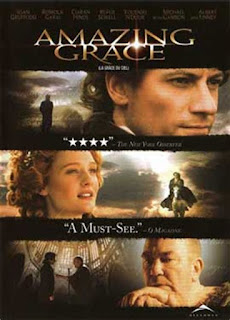
(Definitely watch the movie, Amazing Grace, 2006, starring Ioan Gruffudd as Wilberforce. Excellent!)

The hymn, Amazing Grace, is a testimony to God's saving power, then, of a man who was a wretched sinner (as are we all) but who was bestowed salvation. Just...wow. 

I remember going to a funeral once, and the pastor had us sing AG but changed the lyric from "wretch like me" to "one like me." Because, he said, we are not wretches - God loves us!

Pfffft! Without Christ, we are wretched! We're lost and no better off than a slaver. In fact, in our hearts at this very moment, we would readily enslave anyone who doesn't think like us, act like us, look like us, believe like us. That's the nature of sin.

But praise God, Christ has freed us from this wretched state. I'm still a sinner, but now I'm also forgiven and am a new creation. Thank you, Lord. 

Such is the nature of great hymns. They convey powerful theological truths and transforming Biblical teaching. Really looking forward to this series!

~*~
(via PayPal.Me - an e-book from Tule Fog Press.)
This blog is reader supported. Thank you for your support!
Find me on Facebook where I post nerdy memes and share about my writing projects.

Sunday, January 02, 2022

Reading Through Proverbs

This month, I'm taking the Proverbs challange - reading a chapter a day from the Book of Proverbs. 31 days in January and by coinkidink there are 31 chapters in Proverbs! 

I'm also writing out my GRIP and sharing it with an email bible study group I'm a part of. GRIP stands for God's Word, Reveal, Implement, Prayer. Here's how it works.

First, we read and reflect on a verse or two from the chapter we're reading that day. We write it down - or copy and paste, as the case may be, since I'm using the Bible.com app.

Then we note what God is revealing to us in the passage we just read. We look at the plain meaning of the text, what the verse is teaching or revealing. (Not "what does this verse mean to me" type of thing.)

Once we hear God speaking, we take it personally. What does God want me to do with this revelation? How can I implement what I've learned or put in to practice what I already know to be true?

Round out this time in God's Word with a prayer. I usually ask God to help me follow through with what I just studied. All said and done, about 15 minutes. Then we share those GRIPs with each other via email.

If you're interested in joining the challenge or just want more information, the person who starts us all off in the morning is Scott Lehman and he has a YouTube channel where he shares his GRIP in just a few minutes. 

And he's always open to talking with someone about the Lord. As am I. Feel free to drop me a line if you have any questions or thoughts or just need to talk. Have a great Sunday, this 2nd day of 2022, and this 9th Day of Christmas!

Sunday, November 14, 2021

In God's GRIP - An E-mail Bible Study


I’m in an e-mail small group bible study. You wouldn’t think it would work, but it does.

For us church types, a small group implies fellowship, refreshments, discussion of scripture, and prayer. All that’s missing from the e-mail group I’m a part of is the coffee and donuts. It’s pretty neat.

The ministry is called In His GRIP. If you look at the graphic, you’ll see it stands for God’s Word, Reveal, Implement, and Prayer. Since this ministry was founded within the context of sharing Christ within the golfing community, GRIP is a good acronym.

One needn’t be a golfer to enjoy the benefits of daily bible reading and reflection, however. The point is to get into God’s Word each day, reflect on what God is revealing to you, implement some practical aspect of God’s Word, and pray.

How it works...

The founder, Scott Lehman, starts us off with a short, 3 minute video on their YouTube channel. Then you share your own “GRIP” with others by replying-all to the email chain you’re in. Yes, this is the one time you are allowed to reply-all.

We have a reading schedule, so we know what passage to read every day of the month. From Nov 1-30 we’re reading Psalms 61-90; Dec 1-31 we’ll cover Psalms 91-121. Then in the New Year, a 31 Day Challenge: Proverbs 1-31 from January 1 to 31.

Chapter a day. Great way to read through God’s Word.

So each morning, I open the email, watch the short video and then I usually go to Bible Gateway and read the chapter from the NIV or NRSV (those are just two of many bible translations available).

After reading the passage, I pick one or two verses that struck me and write my GRIP. For example, here’s one I did from John chapter 10 awhile back.

  • G – God’s Word – John 10.3-5 – “The gatekeeper opens the gate for him, and the sheep hear his voice. He calls his own sheep by name and leads them out. When he has brought out all his own, he goes ahead of them, and the sheep follow him because they know his voice. They will not follow a stranger, but they will run from him because they do not know the voice of strangers.” (NRSV)
  • R – Reveal – Jesus, our shepherd, knows his sheep intimately. He calls each of us by name; he knows our needs and personal struggles. He promises to go ahead of us, preparing the way, leading us to green pastures and still waters (that beautiful image from Psalm 23). Sheep that know the shepherd will follow his voice – even if they can't see him – and they won't follow a stranger.
  • I – Implement – I believe Jesus knows me intimately. Of course he knows my name – he's created me and he’s the Lord of the universe. The very hairs on my head are numbered (that's another bible verse, I'm pretty sure!). BUT. Do I know HIS voice? Am I following HIS calling (even though I can't see him literally with my eyes)? Am I too willing to follow the voice of a stranger because I like what the stranger is saying? I should run from the voice of a stranger instead. Now that's some food for thought.
  • P – Prayer – Lord, keep calling (I know you will) and help me become so familiar with your voice that I will drop everything and follow when I hear your commands. Help me easily distinguish between your voice, my own thoughts and desires, and the voice of strangers – especially the ones that want to seek and destroy what is good. Amen.

That’s it. Throughout the day you get to read the other GRIPs as they come in from the various members of the bible study. You gain a lot of insight into the scripture and a person’s life over time. It’s great.

If you’re interested in joining a group, let me know. Just hit reply-all!

Wednesday, November 10, 2021

New Stories at Faith Journeys


Excited about four new stories coming online at Faith Journeys - our app project that "delivers short biblical fiction daily." 

What is Faith Journeys? I'm glad you asked!

From our website: Faith Journeys is an app for reading entertaining and inspirational stories based on biblical characters and events. The stories are fictional. Our authors have added additional characters and story lines to create an encouraging tale of how their characters grew in their understanding of and faith in God.

Our goal is to add new stories on a regular basis. (And we're looking for writers, as well. This is paid gig, y'all. Contact me for details.)

What's new? The following stories are now available (or soon will be) in our Faith Journeys app (for phone or tablet). 

Can you tell which character goes with which story? By the way, the wonderful artwork is by Jacob Aybara. (He's actually my son-in-law as well! So I may be biased, lol.)

Here they are:

  • Daniel and Ezra - Standing Strong by Laura Ware
  • Absalom and King David - A Shakespearian Tragedy by Jeff Chapman
  • Naamah, Noah's Wife - Navigating Life's Perilous Flood by Karen Hollowell
  • The Story of Ruth - A Journey to Faith by Revathi Selwyn. 
Other stories already available include: 

Adam, Methuselah, Abigail, Barabbas, Matthew, Naomi, Rebekah, Samson, Zacchaeus, Phileom & Onesimus, Edud, Mary the Mother of Jesus, Joseph the Carpenter, Barnabas, and Paul the Apostle. 

We'll have Michal and Isaiah coming in the next month or so.

What Bible character do you want to read about? With Faith Journeys you can travel with them in your imagination and discover a possible backstory and find out a little bit more about their context and culture.

Look for all of these on our Faith Journeys website and in the app, which is available as a free download in the Apple and Google Play stores.

Now that you've taken a look (at our website with all that artwork), which characters do you like the best? Who else do you want to read about? Let us know! 

Oh, and be sure to like and follow our Facebook page to keep up with news and new stories. Thanks for dropping by!

Tuesday, September 07, 2021

New Project - Free Bible Story App

My brother Steve and I have launched our latest project!

It's called Faith Journeys, and it's a story app for your phone or tablet.

"Short Biblical Fiction Delivered Daily"


Faith Journeys App is free and comes with two free stories. It is available in the Apple Store and Google Play Store. (There are more stories to borrow or buy - an exciting collaboration wiht our authors as we share a royalty with those whose stories we're publishing.)

I'd be honored if you'd download the app and check it out!

Artwork and Bible characters are by artist and graphic designer, Jacob Aybara, by the way. Check out his work.

Wednesday, March 28, 2018

What Jesus Actually Taught


What did Jesus actually teach?

If you were to distill the teaching and preaching of Jesus into a few words or a short phrase, what would come up with? Love? Forgive others? Care for the poor?

Let me put the question like this: What theme in Jesus’s teaching and preaching is so crucial to understanding him that if you removed it from his lips, you wouldn’t have the biblical Jesus anymore?

You still like the answer of love?

Did you know Jesus only mentions love two times in the synoptic Gospels? He tells his disciples to love God and love your neighbor as yourself (referred to together as the greatest commandment; parallel accounts in Matthew 22.37-39 / Mark 12:30-31 / Luke 10:2) and love your enemies (also in two accounts, Matthew 5.44 / Luke 6.27). [BTW, you can use BibleGateway or Bible Hub to look up verses.]

Out of all the recorded words of Jesus, he devotes two lines to the topic of love.

Evidently, Jesus didn’t make love the hallmark of his preaching. Similar points can be made with other big themes we think are at the core of Jesus’ teaching: forgiveness, serving others, trusting God, helping the poor, defending the oppressed, etc.

Not that these themes are absent from the teaching of Jesus. Not at all. But they aren’t the core, they don’t summarize what is at the heart of the proclamation of Jesus. They actually flow out of his primary message.

Which is? For the biblical answer, we need to simply read what the Gospel writers wrote as their summaries of what Jesus was all about.

Let’s start with the Gospel of Matthew.
  • Jesus went throughout Galilee, teaching in their synagogues and proclaiming the good news of the kingdom and curing every disease and every sickness among the people. (Matthew 4.23)
  • Then Jesus went about all the cities and villages, teaching in their synagogues, and proclaiming the good news of the kingdom, and curing every disease and every sickness. (Matthew 9.35)
  • He then tells his disciples: “As you go, proclaim the good news, ‘The kingdom of heaven has come near.’” (Matthew 10.7)
Very clearly, at the heart of the teaching of Jesus – and the core message he wants his followers to proclaim – is the kingdom of God. In fact, in Matthew 6.10, we are to pray to God, “Thy kingdom come.” And in Matthew 6.33, we are to seek first the kingdom of God.

What is the Kingdom of God?

The kingdom of God (or, often in Matthew, the kingdom of Heaven, same thing) is simply God’s reign. It’s not a realm (a place, like a physical dominion with borders), nor is the kingdom a particular people. The kingdom of God is God’s ruling power or authority present in this world.

Now this kingdom creates a people (those who submit to God’s rule) and impacts a place (where a particular location demonstrates the attributes of the God’s rule). But again, simply put, God’s kingdom equals God’s reign.

Let’s Continue with Luke’s Summary

From Luke 4.16-21, 43.
When he came to Nazareth, where he had been brought up, he went to the synagogue on the Sabbath day, as was his custom. He stood up to read, and the scroll of the prophet Isaiah was given to him. He unrolled the scroll and found the place where it was written: 
“The Spirit of the Lord is upon me, because he has anointed me to bring good news to the poor. He has sent me to proclaim release to the captives and recovery of sight to the blind, to let the oppressed go free, to proclaim the year of the Lord’s favor.” 
And he rolled up the scroll, gave it back to the attendant, and sat down. The eyes of all in the synagogue were fixed on him. Then he began to say to them, “Today this scripture has been fulfilled in your hearing.” 
… He said to them, “I must proclaim the good news of the kingdom of God to the other cities also; for I was sent for this purpose.”
  • See also Luke 8.1 – Soon afterwards he went on through cities and villages, proclaiming and bringing the good news of the kingdom of God.
  • And in Luke 10.8-9 Jesus authorizes his disciples to do what he has been doing: Whenever you enter a town and its people welcome you, eat what is set before you; cure the sick who are there, and say to them, ‘The kingdom of God has come near to you.’

Finally, the Gospel of Mark

The most succinct summary of Jesus’s teaching is in the Gospel of Mark. He tells us right at the outset what the ministry of Jesus is all about.
Mark 1.14-15 – Now after John was arrested, Jesus came to Galilee, proclaiming the good news of God, and saying, “The time is fulfilled, and the kingdom of God has come near; repent, and believe in the good news.”
Three point message, the first and last highlight the core: The kingdom of God has come near.

Yes, love, forgiveness, care for the poor, serving others, etc. are part of Jesus’s message, but they flow from the heart of his teaching and preaching, which is the kingdom of God.

It’s still the core message of the church today: repent and believe the good news that the time is fulfilled and God’s reign is at hand.

For a better understanding of what Jesus was all about, watch the first 12 to 15 minutes of Gordon Fee’s lecture on the Kingdom of God. He explains it better than I just did. In fact, I basically summarized Fee’s points in this blog post. Thanks for reading.

Monday, January 23, 2017

Proclaiming the Year of God's Favor

Citizens of a New Kind of Country
A reflection on the life and politics of Jesus by Lyndon Perry

I’d like to tell you about a man who was born in Palestine a number of years ago. He was seen by more than a few as a revolutionary figure. A Yassar Arafat, if you will; a polarizing figure who spoke of a new government for Israel. This really disturbed the higher-ups, of course, but excited many of the common people who had been living like refugees in their own country – occupied territory! – for many years.

It’s strange, the story of this man. Predictions about him becoming a kind of prime minister, king even, of Israel began when he was born. His mother Mary, for instance, believed God was going to throw princes from their thrones so that her son could reign. His uncle, Zechariah, called him a political savior - like King David of old. When he was born he was even named Yeshua, or Joshua, which means “God will save.” (Of course, we know him by way of his Greek name, Iesous, or Jesus.) It was prophecy fulfilled: this Yeshua was destined to save his people from their oppressors. At least, that is what so many people believed.

You see, foreign armies had occupied the Eastern Mediterranean Seaboard for nearly 400 years. The enemy’s presence was a constant reminder of their once free nation. And the people were bitter, some were divided. All anticipated a day when things would be better.

Yeshua grew up with much the same anticipation, but he was not bitter or alone. There was his cousin, John. They were likely good friends. They must have played together, talked with one another, dreamed of the future – a future where God would rule through one person chosen especially for the task. A messiah. They yearned for this future and had a feeling that they were going to be a part of it somehow.

 As John and Yeshua grew they saw the political climate of Israel change. Revolutionary groups sprung up, died away, and sprung up again. Would-be saviors were killed and their cause humiliated. Yet one loosely organized underground resistance force gained strength and numbers. They were known as the Zealots. Their purpose was to overthrow their oppressors and reestablish a government by the people, for the people - the chosen people!

Neither John nor Yeshua joined the Zealots but each knew the day was coming when they would have to act, when God would call upon them to fulfill their destinies as agents in the new government. So they continued to talk and dream and prepare. For they would have to be ready; one day they would have to act.

One day John did.

Sunday, May 06, 2007

Bible in Georgia Schools? Teach It!

When it comes to biblical literacy, Georgia doesn't want any child left behind.

First the news...From Washingtonpost.com:
Georgia's public schools walk a delicate line as they decide whether to offer the nation's first state-funded Bible classes. . . . The state school board approved curriculum in March for teaching the Bible in Georgia's high schools.
According to the AP article, the implementation of the program is up to each school district and the classes themselves are elective. The guideline - teach it, but don't preach it! Classes are to be taught "in an objective and nondevotional manner with no attempt made to indoctrinate students."

Critics claim the new law will open schools and teachers up to lawsuits for crossing the "Church/State" boundary while others fear that classrooms will become pro-Christian sanctuaries. Another concern is that Georgia's law does not give enough guidance on how to teach the bible since no additional training for teachers is required.

Now my opinion...From Bloggin' Outloud

While these concerns have some merit they aren't any different than what is currently the case in our public (read government run) schools. First, people are lawsuit happy and any perception of a violation of their rights gets some folks' dander up. Second, classes are elective. If Christian students want to turn it into a sanctuary, God bless them. And third, when has there ever been enough guidance on how to teach anything effectively? I say, give it a shot.

The Bible as Literature: Time Magazine's Feature on Bible Literacy Project.

Thursday, July 13, 2006

Answers - T13 Bible Misquotes Edition

Okay, I know this is going to be a contested election, but here are the answers and the references to my Thursday 13 - Bible Misquotes Edition. We'll devote a short paragraph to each. Then I'll give linky recognition below to the winners. And distribute prizes :-)

Ready? The misquotes (not mosquitos) and non-biblical quotes that I had in mind are #s 2, 4, 5, 10, and 13. Here's why...

1. Quote. "In everything I did, I showed you that by this kind of hard work we must help the weak, remembering the words the Lord Jesus himself said: 'It is more blessed to give than to receive.'" (Acts 20:35, NIV, where the Apostle Paul is speaking to the elders in Ephesus.)

Interesting aside. This quote from Jesus is no where found in the Gospels and is therefore part of a tradition of teachings that the four Gospel writers either didn't use or know of.

2. Misquote. Well, it's a real quote but not from the Bible. It's actually from Aesop's Fable, Hercules and the Waggoner, and the saying is, "The gods help them that help themselves." Note the plural. And there is a bit of truth to this statement. That is, you'll never win the lottery if you never buy a ticket. Okay, bad example.

3. Quote. "Do not be deceived: God cannot be mocked. A man reaps what he sows. The one who sows to please his sinful nature, from that nature[a]will reap destruction; the one who sows to please the Spirit, from the Spirit will reap eternal life." (Galatians 6:7,8, NIV, the Apostle Paul writing to the Church in Galatia.)

4. Misquote: "Money is the root of all evil." I know, I know. I originally posted, "The love of money is the root of all evil" (which is what the KJV has), but I was thinking of the NIV's translation which isn't as absolute: "For the love of money is a root of all kinds of evil. Some people, eager for money, have wandered from the faith and pierced themselves with many griefs." (1 Timothy 6:10, the Apostle Paul writing to Timothy.)

5. Misquote: "All things work out for the best." The actual statement by the Apostle Paul to the Church in Rome is, "And we know that in all things God works for the good of those who love him, who have been called according to his purpose." (Romans 8:28, NIV) But I like the Yak's explanation as well:
All things work out according to the will of God, but I don't remember seeing "for the best" (though if you take the position I do, which is that the will of God is for the best, the statement itself may reflect reality, if nonspecifically).
Good call. Still, since this is my game, I'll call it a mosquito.

6. Quote: In 1 Timothy 5:18 we read, "For the Scripture says, 'Do not muzzle the ox while it is treading out the grain,' and 'The worker deserves his wages.'" (NIV)

Interesting to note that the Apostle Paul says both of these proverbs are from Scripture. The first one comes from Deuteronomy 25:4 (from the Torah, so definitely Scripture) and the second is (probably) a common saying utilized by Jesus but recorded by Paul's good friend Luke in his Gospel (Luke 10:7). What's neat is that the Gospels are just starting to circulate at this time and already hold the same authority as the Law and the Prophets (our Old Testament). In a similar manner, the Apostle Peter speaks of Paul's letters as Scripture (2 Peter 3:15,16)

7. Quote: "...with God all things are possible." (Matthew 19:26, NIV, Jesus speaking on the possibility of salvation. The first part of his saying is, "With man this is impossible...") Also in Mark 10:27.

8. Quote: "As iron sharpens iron, so one man sharpens another." (Proverbs 27:17, NIV)

9. Quote: Jesus said, "Then you will know the truth, and the truth will set you free." (John 8:32, NIV)

Sounds sweet. Sounds inclusive. Sounds liberal. But notice the word then. The full quote reveals that Jesus made this caveat, "If you hold to my teaching, you are really my disciples. Then you will know the truth, and the truth will set you free." This caused quite a stir at the original hearing since Jesus just tied the definition of truth to obedience to himself. To his audience it sounded harsh, exclusive, and narrow. Probably should sound that way today as well.

10. Misquote: "Early to bed and early to rise, makes a man healthy, wealthy, and wise." Well, again, an accurate quote but this time from Benjamin Franklin in Poor Richard's Almanack.

11. Trick Quote: "Take life easy; eat, drink, and be merry." Again from Random Yak:
This is in the gospel of Luke (Luke 12:19, NIV), but it doesn't mean what people generally think it means. This is the parable of the rich man - who takes this attitude only to be told "This very night your life is demanded of you."
The lesson? Jesus says to be on our guard against all kinds of greed, and instead, be rich toward God.

12. Quote: Gender neutral paraphrase of the Apostle Paul's admonition to the Church in Thessalonika, "For even when we were with you, we gave you this rule: 'If a man will not work, he shall not eat.'" (2 Thessalonians 3:10, NIV)

13. Misquote: Often called the Golden Rule (the one with the gold rules?), this saying of Jesus is not, "Do unto others before they do it unto you." That's Tony Soprano. The real quote is: "Do to others as you would have them do to you." (Luke 6:31, Matthew 7:12, NIV)

Another interesting note (I'm just full of interesting tid bits, aren't I?) is that, while other religions and cultures have variations on the Golden Rule, often called Silver Rules, Jesus had a unique take on this ethical ideal. He turned what was typically a negative or passive command (e.g. the Buddha said, "Hurt not others with that which pains yourself") into a positive and active ethic of love. Whew! Now it becomes hard! There are some days I would rather follow Tony than Jesus.

So that's it. Anyone want to contest the final answers? As for the winners, I'm too tired tonight to award prizes (they're coming, just . . . later).

Notes:
NIV = New International Version
KJV = King James Version


Thanks for stopping by! Want more to read?
Accept a free ebook when you subscribe to my monthly newsletter!

T13 - Bible Misquotes Edition

Thirteen of Lyn's Favorite Bible Verses

Answers and Winners Posted Here

Do you misquote the bible? Do you realize it when you do?

Here are 13 popular citations, 8 of which are truly found in the Bible.*
Can you identify the 5 misquotes and non-biblical slogans?
Extra credit if you know the references for all 13 quotes. No googling! Okay, googling allowed as I think this might be harder than it looks.

1) It is more blessed to give than to receive.
2) God helps those who help themselves.
3) You reap what you sow.
4) UPDATE: Ahem, now this is a misquote (thanks to all who caught me quoting the actual KJV): The love of [M]oney is the root of all evil.
5) All things work out for the best.
6) The worker deserves his wages.
7) With God all things are possible.
8) Iron sharpens iron.
9) The truth will set you free.
10) Early to bed and early to rise, makes a man healthy, wealthy, and wise.
11) Take life easy; eat, drink, and be merry.
12) If a person will not work, that person shall not eat.
13) Do unto others before they do it unto you.

* Scriptural quotations (or a close paraphrase) based on the NIV Translation. Winners and answers announced later this week. Y'all come back now, ya here?
UPDATE: Answers are now up at this post - too long to add to this one! Enjoy!


Thanks for stopping by!
~*~
(via PayPal.Me - an e-book from Tule Fog Press.) 
This blog is reader supported. Thank you for your support!